A practical guide to departure planning
Lucky Direction Today: How to Check with Qi Men Dun Jia
To check an auspicious direction for a journey, start with your route and departure time. Qi Men Dun Jia lets you compare the traditional readings for the options you actually have.
What you need before checking today’s lucky direction
“Lucky direction today” can mean a personal Feng Shui direction, an almanac’s daily advice, or a Qi Men Dun Jia reading. This guide covers Qi Men departure planning. If you want your personal Kua direction for a desk or bedroom, read the difference between Feng Shui and Qi Men directions first.
For a useful departure comparison, have these details ready:
- Starting point: the place you will leave from.
- Destination: the place you intend to visit.
- Candidate date and departure times: when you can actually leave.
- Time settings: the local time zone and whether you are using standard time or True Solar Time.
A destination can lie east of one starting point and west of another. The relevant direction therefore depends on your route. This page explains the method; your current reading is calculated in the app.
How to compare directions and departure times
- Enter the origin and destination. Use the locations for this journey. The direction to the destination is assessed relative to the origin.
- Select the date or search range. Keep only dates and departure windows that fit your schedule. When comparing hourly readings, use the Hour board.
- Check the time settings. Use the same settings for each candidate. True Solar Time adjusts the time used in the calculation, so a reading near a time boundary can differ from one calculated with standard time.
- Compare the candidate departures. Review the direction score and the selected chart. For this journey feature, the time being assessed is your departure time. Arrival time still matters for your schedule.
- Read the formations and explanation. Look beyond a single favorable Gate. Check the formation analysis (Ge Ju) and use the AI explanation to understand the app’s reading before choosing another candidate.
These steps use the existing direction and time features in Strategic Compass Pro. If you prefer to understand the chart directly, see what an hourly chart contains.
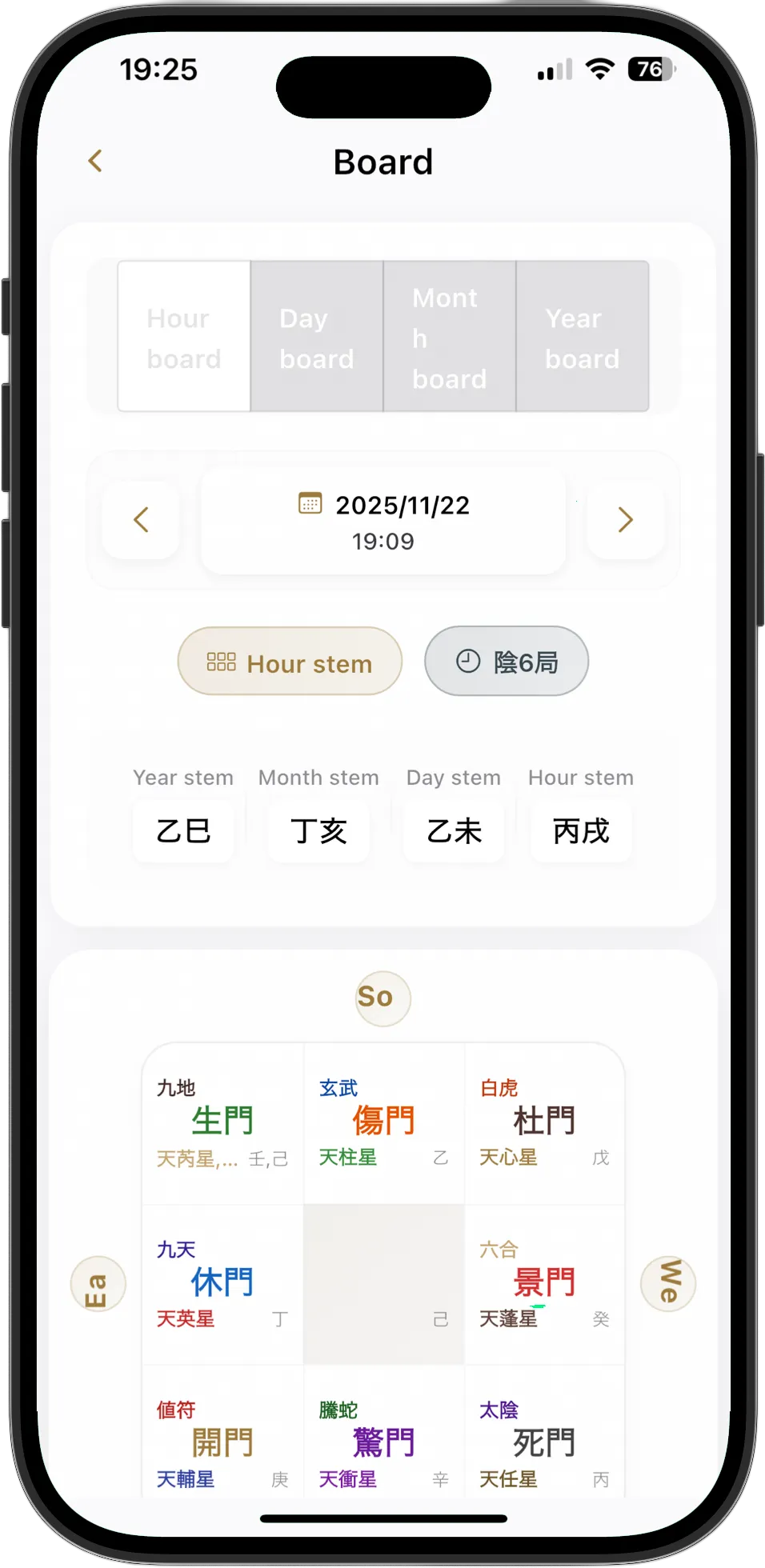
One destination, two possible departure times
Suppose you are visiting a friend and can leave either in the morning or in the afternoon. Keep the same origin and destination, then compare those two departure windows in the app. The route’s direction stays the same, while the time chart may change.
If one candidate receives a more favorable score, open its explanation and compare the formations. Then check the practical details: your friend’s availability, transport times and how much time you have for the visit.
A fair comparison changes one thing at a time. Compare departure times for the same route first. If you change the destination or starting point as well, you are comparing a different journey.
This example deliberately gives no date-specific score. A result needs to be calculated from your inputs; a fixed number on a guide page would not be today’s reading.
What an auspicious-direction score means
The score summarizes how the app evaluates a chart using its Qi Men rules. A higher score represents a more favorable reading within that system. It does not mean a corresponding percentage chance of success.
Consider the chart as one input to planning. A favorable label cannot tell you whether a train is running, a route is accessible or a person is available. Those practical details still decide whether an option works for you.
If the time of an appointment is fixed, compare feasible departures that get you there on time. Changing the departure time is different from changing the appointment itself.
Common questions
Does my lucky direction stay the same all day?
Hourly Qi Men charts commonly use two-hour periods. A direction’s interpretation can change between charts, although it does not have to change every time. The app also has daily, monthly and yearly boards, which should not be treated as interchangeable readings.
Can I use this method for a meeting?
For an in-person meeting, compare feasible departures from your starting point to the venue. An online meeting has no travel direction; use the app’s time-evaluation features for activities without travel instead.
Can I calculate a live chart on this website?
The website provides guides and example screens. The Qi Men calculator runs in the iPhone app, with a 7-day free trial and a subscription required to continue after the trial.
Compare my departure times
Enter your origin, destination and date range in Strategic Compass Pro to see the chart, compare scores and read an explanation on your iPhone.
View Strategic Compass ProFor iPhone. 7-day free trial. Subscription required to continue after the trial.